

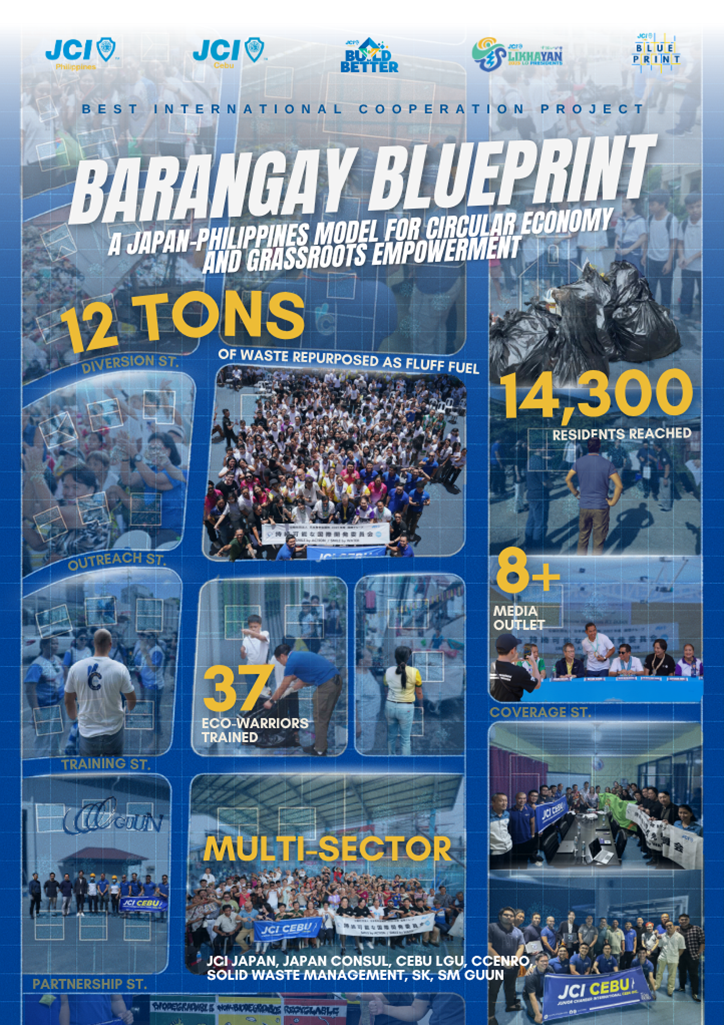
Barangay Blueprint
How might we make waste segregation work where it has always failed: at home, on the streets, and across cultures?
That was the core question Barangay Blueprint sought to answer, not with theory, but with feet on the ground and hands in the trash. JCI Cebu and JCI Japan didn’t just sign a cooperation agreement, we walked the streets at night and early in the morning only to see trash dumped in the streets of Cebu City, saw overflowing waterways, visited landfills, and sat with barangay leaders to listen (even met barangay leaders who have already given up on the problem, “What will do to the people? Kick them if they don’t segregate? For what? We’re just putting all trash anyway in the landfill”). From those lived encounters, a blueprint was born.
Barangay Blueprint became the largest civic movement of JCI Cebu in 2025, co-designed with JCI Japan’s Sustainable International Development Commission, supported by Chairman Oizumi, and joined by Ambassador Fumiya, a Japanese celebrity who danced with students and sorted trash with mothers. From the Philippines, JCI Philippines’ International Affairs Group and Cebu City Mayor Archival played pivotal roles, recognizing that global ideas must ground themselves in local action.
JCI Japan brought strategy, discipline, and a lens of international diplomacy. JCI Cebu brought cultural fluency, community organizing, and bold experimentation. Together, they prototyped what waste segregation could look like if people were rewarded for doing it right.
This cooperation created shared learning: Japan saw firsthand the resilience of Philippine barangays, while Cebu members gained technical knowledge and confidence to scale impact. Beyond results, the project built trust, friendships, and systems.
Barangay Blueprint is not a one-off project, it’s a replicable system designed by the people, for the people, through the lens of global cooperation. Its success is not measured only by tonnage or pesos, but by belief restored that local citizens, when guided, rewarded, and heard, can lead the sustainability movement.
This is why JCI World must see Barangay Blueprint not as a moment, but as a model.