

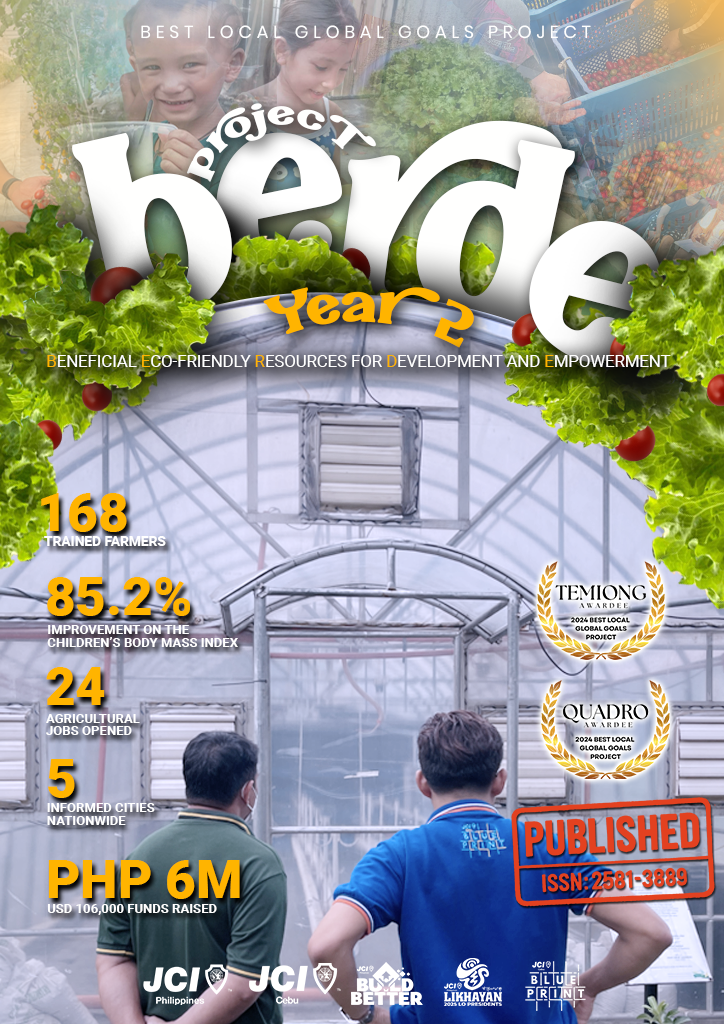
Project Berde Year 2: Beneficial Eco-Friendly Resources for Development and Empowerment
Amid rising hunger, malnutrition, and underemployment, Project BERDE was conceived as a bold, youth-led response to one of Cebu’s most pressing challenges: ensuring access to healthy food and sustainable livelihoods for all. By promoting innovation, collaboration, and a commitment to measurable impact, the project seeks to redefine how communities can rebuild, invest, sustain, and evolve. The project aligned with the JCI RISE pillars and the UN Sustainable Development Goals.
Specifically, Project BERDE aims to:
-
Address food insecurity among Cebu’s vulnerable population, where 28% lack access to fresh, nutritious food, leading to malnutrition, stunting (33% of Filipino children), and preventable diseases.
-
Transform underutilized spaces and boost agricultural productivity (only 3% of the national budget supports agriculture, despite its 10% GDP contribution) through scalable hydroponics farming.
-
Empower communities and create livelihoods, raising agricultural employment from 25% to 46%, training 168 farmers and youth, and generating 24 jobs nationwide.
-
Build and sustain resilient food systems, ensuring nutrition, economic growth, and environmental stewardship in line with 8 UN SDGs and the JCI RISE vision.
-
Scale impact beyond local borders, positioning Cebu as a model of youth-driven, data-based, and globally replicable solutions to hunger, underemployment, and climate resilience.
- Benchmark and inform communities nationwide by expanding the project’s best practices to Baguio, Malate, Guimaras, and Davao, fostering awareness, capacity building, and partnerships beyond Cebu.